
Candle Pour Temperature: A Per-Wax Guide That Actually Works
Pour temperature decides wet spots, frosting, scent throw, and whether your fragrance survives the bottle. Here are the exact ranges I use for soy, coconut soy, beeswax, and paraffin.
Prices updated June 26, 2026
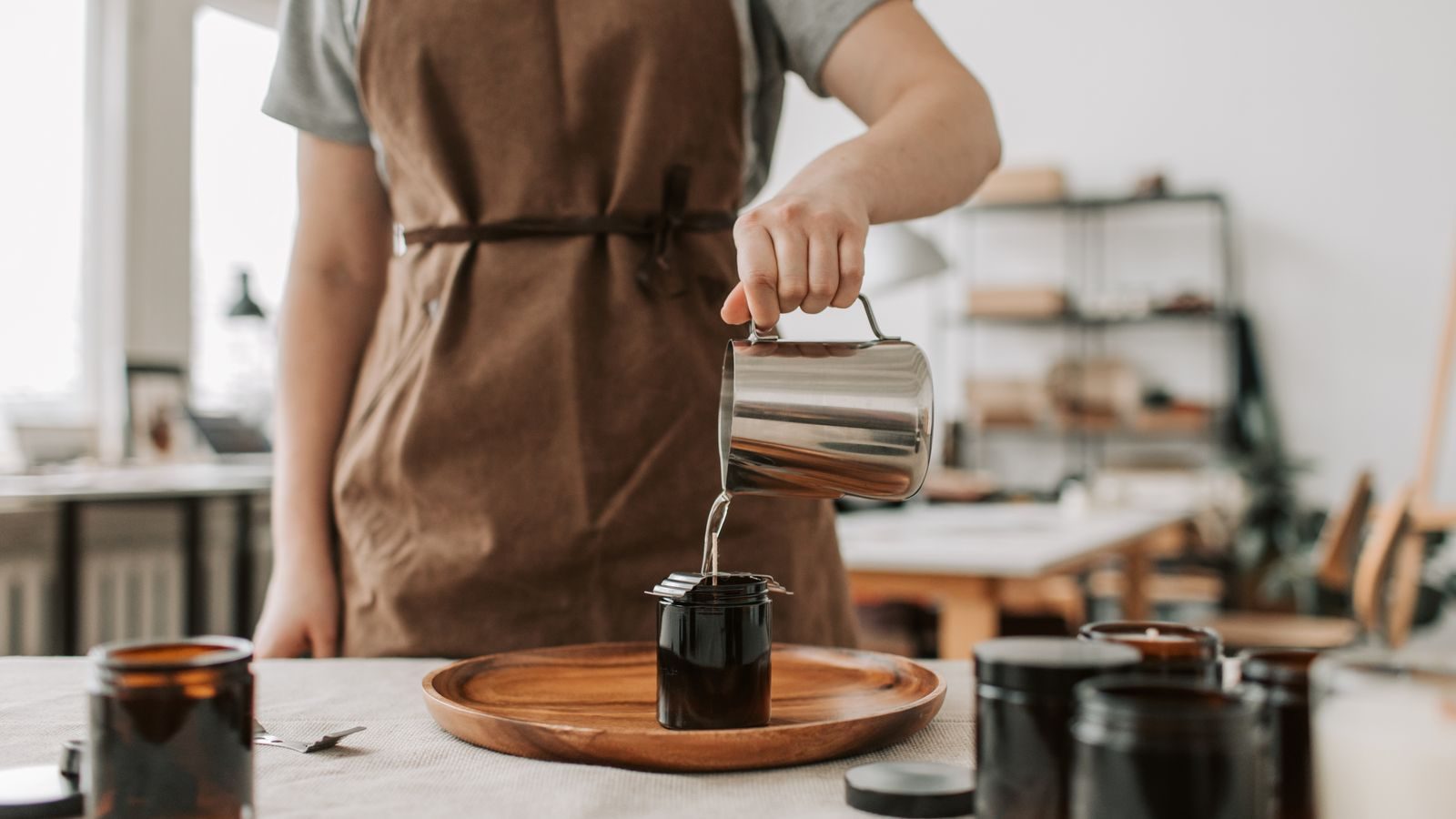
If I could change one habit in new candle makers, it would be how they treat temperature. Confirm the best wax for candles match first, because every wax has its own pour window. Most pour by eye, get inconsistent results across batches, and blame the wax. The wax is fine. The thermometer was in the drawer.
Three numbers run the whole pour: the melt-down temperature (how hot you take the wax to liquefy it cleanly), the fragrance-add temperature (where you stir in the oil), and the pour temperature (where you tip it into the jar). Each one does a specific job. Each one has a useful range, not a single right answer.
Here is the per-wax guide I actually keep on the wall.
The three temperatures, what each one does
Melt-down temperature sets whether the wax goes fully liquid and any leftover crystalline structure breaks down. Too cool and you'll get streaky tops as residual crystals seed uneven set. Too hot (above about 90°C for soy) and you start oxidising the wax, which gives a faintly off smell on the burn and weakens long-term throw.
Fragrance-add temperature sets whether the fragrance binds into the wax matrix or sweats out later. Too cool and the oil pools rather than emulsifying. Too hot and the volatile top notes flash off (and you risk crossing the flashpoint).
Pour temperature sets the surface finish, the wet-spot rate, and the frosting on soy. Too hot into a cold jar = wet spots. Too cool = sinkholes and dished tops. The window for a clean pour is tighter than people think.
Soy, US (Golden 464, NatureWax C-3, EcoSoya Q230)
- Melt-down: 80–85°C. Hold for 2 minutes once fully liquid.
- Add fragrance at: 80–85°C, same as melt-down. Stir gently for 2 minutes.
- Pour at: 55–65°C. The narrow band depends on jar temperature; see below.
US soy is the most temperature-sensitive of the popular waxes. Pour above 70°C and you'll get wet spots even with pre-warmed jars. Pour below 50°C and the wax starts setting before it self-levels, giving you sinkholes and rough tops.
The single biggest fix for inconsistent soy is pre-warming the jars to 40–50°C for 10 minutes before pouring. With warm jars, you can pour at the lower end of the range (55–60°C) and get clean glass adhesion plus a smooth top. The wet-spots guide has the full pre-warm routine.
Soy, EU (KeraSoy 4130)
- Melt-down: 80–85°C.
- Add fragrance at: 75–80°C, once the wax settles below the wax-side minimum.
- Pour at: 60–70°C. Pouring at 464 temperatures (55–60°C) leaves 4130 with sinkholes; it wants that extra 5°C to 10°C to self-level.
KeraSoy 4130 is the EU/UK counterpart to 464 but not a substitute: the pour window is roughly 5°C to 10°C hotter, the wick series you reach for first is 4Candles CL or TB (not Stabilo), and the cure peaks a day or two earlier. Every troubleshooting rule of thumb calibrated for 464 needs re-testing before you trust it here.
Coconut soy blends (CoCoSoy, Cal-Wax C3, Virginia Candle Supply CB-Advanced)
- Melt-down: 75–80°C.
- Add fragrance at: 75–82°C.
- Pour at: 50–60°C.
Coconut soy is more forgiving than pure soy. It pours cooler, sets more uniformly, and is much less prone to frosting. The pour window is wider (about 10°C of latitude vs 10°C for pure soy with pre-warmed jars, but the failure modes at the edges are gentler).
If you're switching from pure soy to a coconut blend, drop your usual pour temperature by 5°C and pre-warm jars to the same 40–50°C. Most coconut-soy complaints I see are makers carrying over their hotter soy pour temperature out of habit.
Beeswax (filtered, cosmetic-grade)
- Melt-down: 65–70°C. Beeswax melts at 62–65°C and you only need 5°C of headroom.
- Add fragrance at: 70°C maximum. Beeswax barely binds fragrance, so anything beyond a 6% load is wasted; see the wax guide.
- Pour at: 70–75°C. Yes, hotter than soy. Beeswax sets fast.
Beeswax is unusual: it's the one wax you pour hot, because it has such a narrow liquid window between melt and set. Pre-warming jars to 50–60°C is essential or the wax skins on contact and gives you a corrugated wet-spot pattern that's nearly impossible to fix.
Filtered beeswax is far easier to work with than raw beeswax for first-time pourers. Raw beeswax holds propolis and pollen that scorch above 75°C and discolour the candle.
Paraffin (container grade, IGI 4630, IGI 6006)
- Melt-down: 80–85°C.
- Add fragrance at: 80–85°C.
- Pour at: 70–80°C. Paraffin tolerates a wider, hotter pour than soy.
Paraffin is the most forgiving wax on temperature. The pour window is broad, jar pre-warming matters less (the wax shrinks less than soy on cure, so wet spots are rare anyway), and the finish is glossy across most of the range.
If you're new to candle making and want a wax that hides temperature errors while you learn, this is it. Most makers move to soy or coconut soy later for brand reasons, not technical ones; see the soy-vs-paraffin comparison.
Coconut wax (pure, not blend)
- Melt-down: 75–80°C.
- Add fragrance at: 75–80°C.
- Pour at: 50–55°C. The coolest pour of any wax here.
Pure coconut wax is soft and creamy. It pours cool, sets slowly, and demands pre-warmed jars (40–50°C) and a still room. Get the cool pour right and the finish is the smoothest of any container wax.
The fragrance flashpoint clamp
Whatever the wax's ideal add-temperature, never add fragrance to wax that is hotter than (flashpoint minus 5°C). If a fragrance has a 75°C flashpoint and your soy wants fragrance added at 80°C, you have two choices: switch fragrance, or add it cooler (70°C) and accept a slightly weaker bind. The Fragrance Oil Calculator and the Recipe Builder both flag flashpoint conflicts and recommend an adjusted add-temperature automatically.
Low-flashpoint citrus essential oils (typically 45–55°C) cannot be added at any normal pour temperature. Either pick a higher-flashpoint variant from a different supplier, or accept that the EO is going in below 45°C, will barely bind, and will throw quietly. The fragrance comparison guide has the full picture.
The thermometer that earns its place
A $19 digital probe thermometer with a clip-to-pitcher base reads in 2 seconds and lets you watch the temperature drop as you stir. That's the kit. An infrared thermometer reads the surface of the wax, not the body, and the surface temperature lags the body by 5–10°C. Surface IR readings are why some makers pour too hot consistently. Use a probe.
A wall-chart version
If you only remember three lines from this guide, make them these.
- Soy: melt 80–85°C, add fragrance 80–85°C, pour 55–65°C into pre-warmed jars.
- Coconut soy: melt 75–80°C, add fragrance 75–82°C, pour 50–60°C.
- Beeswax: melt 65–70°C, add fragrance up to 70°C, pour 70–75°C into 50–60°C jars.
Updated 25 June 2026. Fact-checked against BS EN 15493:2019 surface-temperature guidance.
Frequently asked
Updated 2026-06-20. Fact-checked against BS EN 15493:2019. Candles. Specification for fire safety.
The Maker's Codex, as a PDF
The full five-act manual. Bench setup, wick sizing, scent throw, pricing, compliance, scaling. Cited to EN 15493, ASTM, IFRA and CLP. We email your regional edition (metric or imperial, GBP, EUR, USD, CAD, AUD).
Best Wax for Candles: An Honest Maker's Guide (2026)
I've poured every common candle wax through the Bristol studio. Here's what soy, coconut, paraffin, beeswax, apricot and rapeseed actually feel like to work with, and which one fits the candle you want to sell.
How to Start a Candle Business: A Realistic 90-Day Plan
A working chandler's 90-day plan to go from first pour to first paid order. Kit budget, first 10 SKUs, batch costing, channel choice, and the compliance checklist that keeps you out of trouble.
Beeswax vs Soy Candles: A Real Comparison
Burn time, scent throw, environmental impact, and cost compared honestly. The right answer depends on what you're optimizing for.
How to Fix Candle Tunneling (and Stop It Coming Back)
Tunneling is a wick-and-first-burn problem, not a wax problem. Three rescue methods that work, plus the upstream fix so the next pour burns edge to edge.