
Candle Making Supplies Checklist: What You Need to Start
The candle making supplies and equipment a beginner actually needs: a checklist, what each tool does, how a double boiler works, and what to leave for later.
You need fewer supplies than a craft shop suggests. Six tools and six materials cover a first batch of container candles, and the tools last for years.
This list is for soy container candles, the easiest place to start. Pillars, votives and other types need a few extras, covered in types of candles you can make.
The checklist
Tools you buy once
- Digital scale that reads to a tenth of a gram
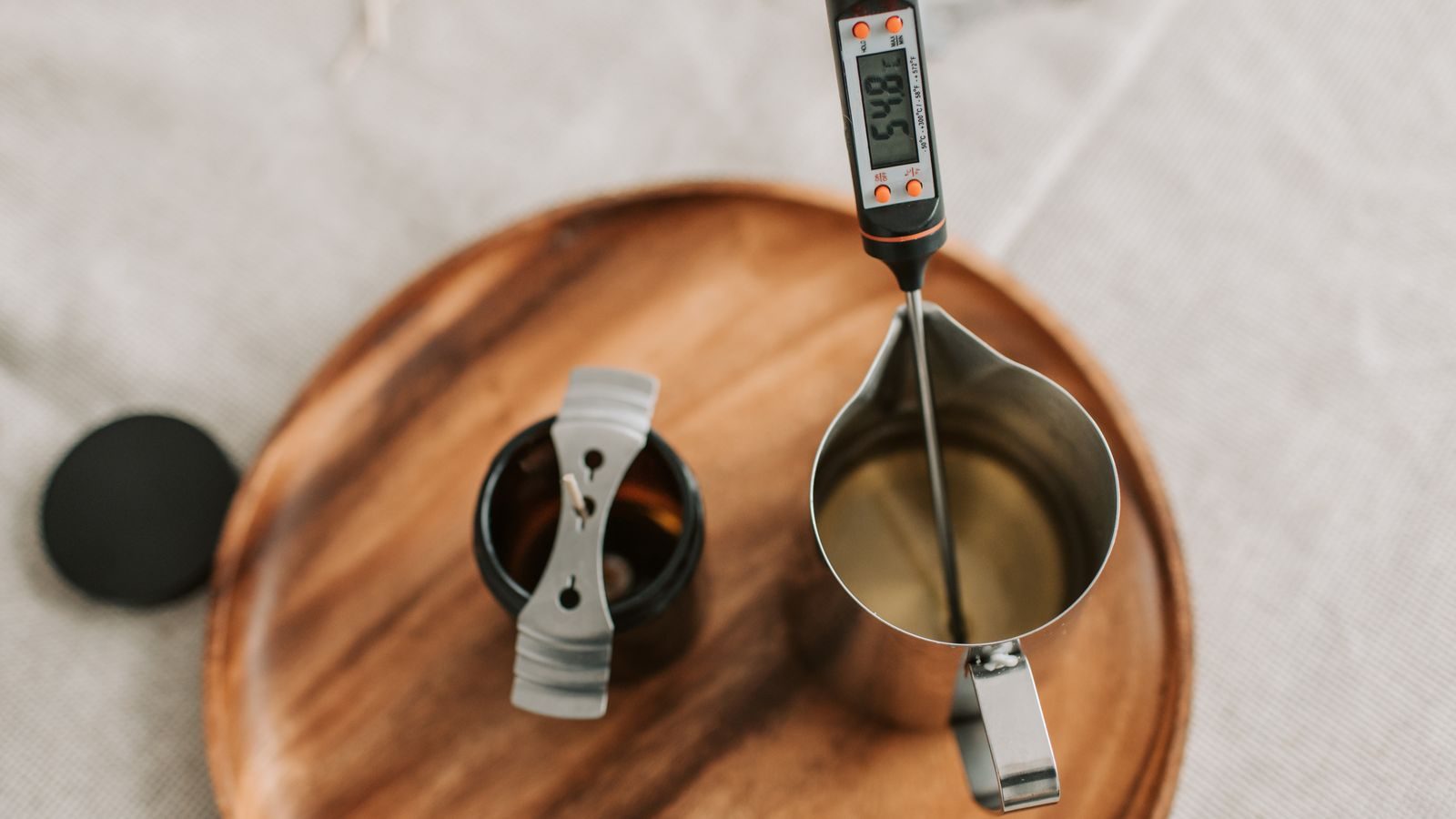
- Digital probe thermometer
- Metal pouring jug, about a litre or larger
- Saucepan wide enough to stand the jug in
- Wick centring bars
- Fire blanket, kept within reach of the hob
Materials for each batch
- Container wax: Golden Wax 464 in the US, KeraSoy 4130 in the UK and EU
- Pre-tabbed wicks sized to your jar
- Wick stickers or glue dots
- Heat-safe jars or tins sold for candles
- Fragrance oil made for candles, with its IFRA certificate and safety data sheet
- Warning labels, which you need before you sell
Useful, not essential
- Heat gun for smoothing rough tops
- Wick trimmer
- Silicone spatula or stainless steel spoon for stirring
- Kitchen paper and old newspaper to protect the bench
- Nitrile gloves for handling fragrance oil
- A notebook, or the Maker's Log, for every batch
What each tool is for
The scale. Wax and fragrance are measured by weight, never by volume. Fragrance load is a percentage of the wax weight: at 8%, 600 g of wax takes 48 g of fragrance oil.
The thermometer. Soy wax has three temperatures that matter: melt, fragrance and pour. Pour too hot and you get wet spots; too cool and you get sinkholes. The pour temperature guide lists all three for each wax.
The pouring jug. The wax melts in the jug, and the jug pours into the jars. A good spout gives a clean, steady pour down the side of the glass.
Wick centring bars. They hold each wick upright and centred while the wax sets. A wick a few millimetres off-centre makes the candle tunnel down one side.
The fire blanket. Water on a wax fire throws burning wax across the room. A fire blanket smothers it; the safety guide also covers the right extinguisher.
Do you need a double boiler?
Not a separate one. Stand the metal pouring jug in a saucepan with about 50 mm of water, bring the water to a simmer, and the pair works as a double boiler.
The water bath is the safety feature. Water can't get hotter than boiling, so the wax warms gently instead of overheating on direct heat. Never melt wax in a pan placed straight on the hob.
Keep the water topped up so the pan never boils dry, and never leave melting wax unattended.
Some supplier starter kits are built around a microwavable jug instead. If you go that way, follow the wax supplier's own instructions and check the temperature before you add fragrance.
Choosing the materials
Wax. Start with one soy container wax. The soy wax guide covers how it behaves, and the best wax guide compares the alternatives.
Wicks. Wick size follows the inside diameter of the jar. Use the wick size chart for a starting size, then test-burn.
Jars. Buy vessels sold for candles, all one size for the first batch. The container guide explains how glass, tins and ceramics differ.
Fragrance oil. Buy oil made for candles from a supplier that publishes its IFRA certificate and safety data sheet. You need both to set a safe fragrance load and, later, to label candles for sale.
What to leave out for now
- An electric wax melter. A jug in a saucepan does the same job for a first batch.
- Several waxes and fragrances. One of each makes every result easier to read.
- Crayons for colour. They aren't made to burn and can clog the wick.
- Moulds, unless you want pillars or votives.
If you plan to sell
Selling adds paperwork more than equipment: warning labels, the fragrance documents above, and usually product insurance. The legal requirements guide covers the UK, EU and US.
To see what all of this costs, read how much candle making costs. To use it, follow the seven-step guide to your first batch.
Frequently asked
Updated 2026-11-26. Fact-checked against CandleScience: What basic candle making supplies do I need?.
The Maker's Codex, as a PDF
The full five-act manual. Bench setup, wick sizing, scent throw, pricing, compliance, scaling. Cited to EN 15493, ASTM, IFRA and CLP. We email your regional edition (metric or imperial, GBP, EUR, USD, CAD, AUD).
Best Wax for Candles: An Honest Maker's Guide (2026)
I've poured every common candle wax through the Bristol studio. Here's what soy, coconut, paraffin, beeswax, apricot and rapeseed actually feel like to work with, and which one fits the candle you want to sell.
How to Start a Candle Business: A Realistic 90-Day Plan
A working chandler's 90-day plan to go from first pour to first paid order. Kit budget, first 10 SKUs, batch costing, channel choice, and the compliance checklist that keeps you out of trouble.
Beeswax vs Soy Candles: A Real Comparison
Burn time, scent throw, environmental impact, and cost compared honestly. The right answer depends on what you're optimizing for.
How to Fix Candle Tunneling (and Stop It Coming Back)
Tunneling is a wick-and-first-burn problem, not a wax problem. Three rescue methods that work, plus the upstream fix so the next pour burns edge to edge.